Valley of Flowers Bloom Calendar
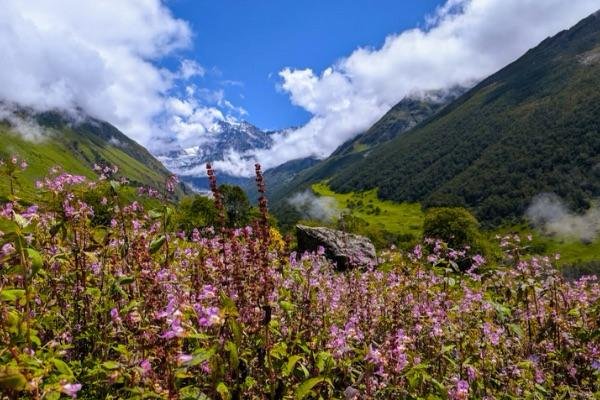
If there is a heaven on earth for botanists and individuals who enjoy being in nature, it is at 12,000 feet in the Chamoli district, Uttarakhand. The Valley of Flowers National Park is like an ever-changing kaleidoscope. Your only dilemma is that the valley does not “bloom” only once. It is a living and changing masterpiece that can look entirely different from one week to another.
There is a question I am frequently asked: “When is the best time to see the flowers?” Actually, it is up to you to decide which colors of the flowers you would like to see. Below is your month-wise guide to the valley’s floral secrets.
July: The Awakening of the Blue Poppy
July is when the monsoon is in full swing, and the valley certainly gets its share of rain. For people who wish to see the “Queen of Himalayan Flowers” the Himalayan Blue Poppy it is the most appropriate time to come.
By the middle of July, most of the glaciers have already melted, thus the soil is moist and rich in nutrients. You will be able to observe the wild White Anemones and Geraniums growing in vast colonies, which will make the meadows look purple and white, respectively, and the whole area will be covered with purple and white spots. It may be a bit of a wet hike, and yes, you may get a few leeches; however, the sight of the first wave of orchids and the presence of the rare Cobra Lily definitely justifies the effort.
August: The Peak of the Riot
In case you want to witness the valley being at its most crowded both with people and flowers August is your month. And what a month that will be! This is the main blooming season.
During the first half of August, the biodiversity of the valley is at its highest. That is why the quantity of flowers you are going to see will be more than you can imagine. At that time, the Braham Kamal (the state flower of Uttarakhand) is ready to bloom at the very top of the mountain near Hemkund Sahib. There will be a lot of pink Himalayan Balsam and yellow Marigolds in the valley. If this is the case, then a photographer will not miss the opportunity to take pictures under the misty clouds with the vibrant petals and produce a cinematic atmosphere that is nowhere else on earth.
September: The Golden Farewell
With September, the valley starts to transform as the heavy rains have ceased. The lively pinks and blues are fading away in favor of gold and burnt orange.
Even though the “carpet” of flowers is not so thick as before, the air is very fresh and the sky is of a deep and brilliant blue. You can still see the Himalayan Knotweed, and what is more important, the valley is full of berries. The local animals like the Himalayan Black Bear and rare birds will be coming to eat the berries. It is an ideal time for trekkers who desire solitude and an unobstructed view of the mountains rather than a packed trail.
Pro Tips for Your Floral Pilgrimage
- The 15th August Rule: The first couple of weeks of August have been said to be the “gold standard” as far as the concurrency of flowering species is concerned.
- Safety First: The months of July and August are those of the monsoon season. There might be landslides on the way to Govindghat, so you should have an extra “buffer day” in your schedule, which you can use if necessary.
- The Hemkund Factor: There is more to the valley than just taking a walk on the floor of it. Within the trek to Hemkund Sahib that is at a further height of 2,000 feet, there are such species as the Blue Poppy and Brahma Kamal that are not always found in the lower meadows.
There are only four months in a year when one can see the Valley of Flowers in all its glory and those are June through October. Once the valley is covered in snow and the flowers are hidden under a white blanket, waiting for the next summer to start the show all over again.