If you are planning the Adi Kailash Yatra in 2026, you probably have many questions about permits, weather, routes, costs, altitude, accommodation, and fitness preparation. In this complete guide, we will cover everything in detail — from the spiritual importance of Adi Kailash and Om Parvat to itinerary planning, packing tips, health precautions, travel budget, local culture, and practical ground-level advice for beginners.
Introduction to the Sacred Adi Kailash Yatra
Adi Kailash, also known as Chhota Kailash, is one of the most spiritually significant pilgrimage destinations in the Indian Himalayas. Located in the remote Pithoragarh district of Uttarakhand near the Indo-Tibetan border, this sacred mountain is believed to be the earthly abode of Lord Shiva and Goddess Parvati. For many devotees and trekkers, the Adi Kailash Yatra offers a deeply spiritual Himalayan experience within India, especially for those who cannot undertake the Kailash Mansarovar Yatra in Tibet.
Unlike a normal hill station trip, the Adi Kailash Om Parvat Yatra takes you into a completely different world. The journey passes through ancient Kumaoni villages, narrow mountain roads, high-altitude valleys, river crossings, and isolated Himalayan landscapes where mobile networks disappear for hours. That raw and untouched environment is one of the biggest reasons why this yatra feels so special.
Historically, this region remained inaccessible for most travellers and was mainly visited by local villagers, sadhus, and experienced pilgrims. In recent years, improved mountain roads and better infrastructure have made the Adi Kailash trek more accessible, although the journey still demands patience, preparation, and respect for the mountains.
The route generally starts from Kathgodam or Haldwani and continues towards Dharchula, Gunji, Nabi, and Kutti village before reaching Adi Kailash. During the journey, travellers also witness the famous Om Parvat, where a naturally formed snow pattern resembles the sacred Hindu “Om” symbol. For many pilgrims, witnessing Om Parvat becomes one of the most emotional moments of the entire yatra.
Standing at an altitude of around 5,945 meters, Adi Kailash is one of the Panch Kailash peaks mentioned in Hindu mythology. The surrounding region lies near the confluence of India, Nepal, and Tibet, where the Kali River and Kuthi Yankti River shape dramatic Himalayan valleys and rugged landscapes.
One important thing travellers must understand is that this is not a luxury mountain vacation. Long driving hours, unpredictable Adi Kailash weather, high-altitude conditions, and limited facilities make proper planning extremely important. Physical fitness, acclimatization, and mental preparedness play a major role during the journey.
Most travellers complete the Adi Kailash Om Parvat Yatra in around 7 to 10 days depending on weather conditions, road situations, permit clearance, and travel pace. Despite the challenges, the peaceful atmosphere, spiritual energy, and untouched Himalayan beauty make this one of the most unforgettable journeys in Uttarakhand.
The Spiritual Significance of Chhota Kailash and Adi Kailash
In the grand tapestry of Vedic cosmology, Adi Kailash holds a position of primordial importance. It is widely referred to as Chhota Kailash (Little Kailash) because of its uncanny physical resemblance to the Tibetan Kailash. According to local lore and the Skanda Purana, this was the primary residence of Lord Shiva before he moved to Mount Kailash. The mountain is considered the “replicate” of the cosmic axis. When you gaze upon its pyramid-like structure, you are looking at what devotees believe to be a physical manifestation of the divine.
The spiritual weight of the Adi Kailash yatra is amplified by the presence of Parvati Sarovar at its base. Legend says that Mata Parvati used this high-altitude lake for her daily ablutions. Nearby stands a temple dedicated to Shiva and Parvati, where the air is thick with the scent of incense and the chanting of pilgrims. The reflection of the peak in the turquoise waters of the Sarovar is said to wash away the karmic debts of a lifetime.
Furthermore, the connection to the Pandavas adds another layer of sanctity. It is believed that the Pandava brothers, along with Draupadi, spent significant time in these valleys during their final journey toward the heavens. Every cave, stream, and rock in the Vyas Valley has a story attached to the Mahabharata. This isn’t just a trek; it’s a walk through a living museum of Indian spirituality. To visit Adi Kailash is to touch the roots of ancient Indian civilization.
Adi Kailash Weather Guide: Best Months to Plan Your Journey
Understanding Adi Kailash weather is the most critical part of your planning. The window of opportunity is narrow due to the extreme winters and the monsoon’s impact on Himalayan roads.
The best time for the Adi Kailash Yatra is usually between May and October. During these months, roads remain comparatively accessible, and weather conditions become safer for travel.
Summer Season (May to June)
Summer offers pleasant daytime temperatures and relatively stable road conditions. Snow starts melting at higher elevations, and mountain views become clearer. This is considered one of the safest periods for families and beginner travellers.
Day temperatures usually remain comfortable, but nights can still become extremely cold, especially near Gunji and Kutti.
Monsoon Season (July to August)
This period brings lush green valleys and dramatic landscapes, but landslides and road blockages become common. Travellers should prepare for delays and changing weather conditions.
If travelling during monsoon:
Carry waterproof gear
Keep buffer days
Avoid tight travel schedules
Autumn Season (September to October)
Autumn is often considered the best season for clear mountain views. The skies remain cleaner after monsoon, making Adi Kailash and Om Parvat visibility much better.
Night temperatures drop significantly during late October, and cold weather preparation becomes important.
Winter travel is generally not recommended because heavy snowfall can block roads and make routes inaccessible.
How to Reach Adi Kailash and Om Parvat: Transport Guide
- By Air: The nearest airport is Naini Saini Airport in Pithoragarh. While small-flight connectivity from Delhi and Dehradun has improved, it remains weather-dependent. Most travelers prefer flying into Jolly Grant Airport (DED) in Dehradun or Pantnagar Airport, followed by a road journey.
- By Rail: The Kathgodam Railway Station is the most reliable railhead. From Delhi, you can take the Ranikhet Express (overnight) or the Kathgodam Shatabdi (daytime). From Kathgodam, the road journey to the base town of Dharchula takes approximately 8–10 hours.
- By Road (The Crucial Leg): The most common route is Delhi → Haldwani → Pithoragarh → Dharchula. Once you reach Dharchula, the “civilized” roads end, and you enter the high-altitude border zone. From here, only 4×4 vehicles like the Mahindra Bolero or Scorpio are permitted to navigate the rugged terrain toward Gunji and Jyolingkong.
A complete Itinerary for the Adi Kailash Om Parvat Yatra
A typical Adi Kailash om parvat yatra starting from Kathgodam or Pantnagar takes about 8 to 9 days.
- Day 1: Kathgodam to Pithoragarh/Chaukori. A long drive through the winding roads of Kumaon. Enjoy the views of the Nanda Devi range.
- Day 2: Pithoragarh to Dharchula. This is where the journey begins. Dharchula is the base where permits are verified and medical check-ups are conducted.
- Day 3: Dharchula to Gunji/Nabi. A dramatic drive along the Kali River, which forms the border with Nepal. You will pass through high-altitude check-posts like Chialekh.
- Day 4: Nabi/Gunji to Om Parvat and Back. An early morning drive to Nabhidhang to witness the miracle of Om Parvat. The “Om” symbol is formed by the natural deposition of snow in the mountain’s crevices.
- Day 5: Nabi to Jyolingkong (Adi Kailash Base). Reach the base of the sacred peak. Visit Parvati Sarovar and the Shiva-Parvati temple.
- Day 6: Exploration and Descent. After a morning darshan of Adi Kailash, begin the return journey to Gunji or Nabi.
- Day 7: Gunji to Dharchula. A long descent back to the warmth of the lower valleys.
- Day 8: Dharchula to Kathgodam. Final departure.
How to Apply for the Adi Kailash Inner Line Permit
Because the Adi Kailash trek is located near the international borders with Tibet and Nepal, an Inner Line Permit (ILP) is mandatory for all the people.
- Documentation: You will need a valid Aadhar Card, a Police Verification Certificate (PVC) from your local police station, and a medical fitness certificate.
- Application Process: You can apply through the SDM office in Dharchula or Pithoragarh. Most travelers find it easier to let their adi kailash tour package operator handle this, as it requires physical presence and local coordination.
- Physical Verification: Even with a pre-approved permit, you must present yourself at the Dharchula office for a final briefing and physical document check.
- Important Note: The PVC can take 10-15 days to process at your home station, so plan well in advance. Without this document, your yatra will end at Dharchula.
Spiritual Sites and Sacred Temples on the Adi Kailash Yatra
The Adi Kailash om parvat yatra is punctuated by sites that are mentioned in the ancient Vedas.
- Kuti Village: Named after Mata Kunti, this is one of the last inhabited villages before the high passes. The stone architecture and ancient carvings here are mesmerizing.
- Om Parvat: One of the biggest highlights of the journey, Om Parvat attracts pilgrims because of the naturally formed “Om” symbol visible on the mountain.
- Parvati Sarovar: Located near Adi Kailash, this sacred lake is believed to be associated with Goddess Parvati. Many pilgrims meditate and perform rituals near the lake.
- Kali Temple at Dharchula: Many pilgrims begin their spiritual journey after seeking blessings here before moving toward higher Himalayan regions.
- Gauri Kund: A small, high-altitude pond near the base of Adi Kailash where the water is believed to have healing properties.
- Patal Bhuvaneshwar: Though often visited on the way to or from the trek, this limestone cave temple is a subterranean wonder where the entire Hindu pantheon is said to be present in stalactite formations.
- Nabhidhang: The viewing point for Om Parvat. The energy here is palpable, and many pilgrims spend hours in meditation facing the mountain.
The Divine Mystery of Adi Kailash Om Parvat
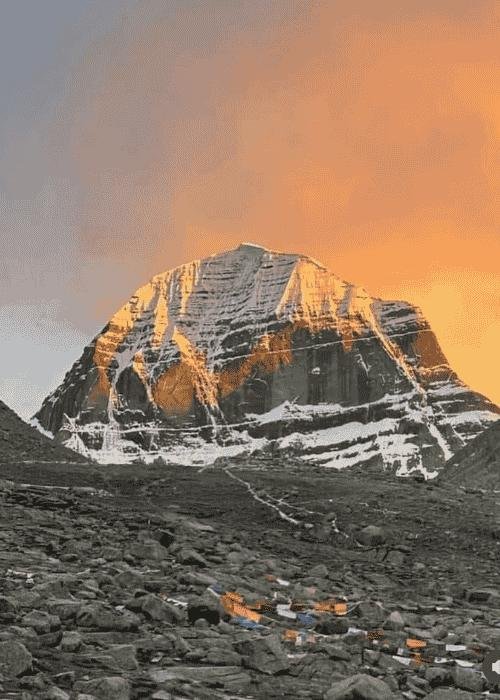
The most fascinating aspect of the adi kailash om parvat is the natural formation of the “Om” symbol. Unlike other religious sites where symbols are man-made, the Om on this peak is a geological and meteorological miracle. The snow settles into the rock fissures in such a way that the Sanskrit syllable “ॐ” is clearly visible from miles away.
Scientific skeptics call it “pareidolia,” but for the thousands who trek here, it is a divine signature. Interestingly, the Om is only visible from the Indian side of the border. As you stand at Nabhidhang, looking up at the 6,191-meter peak, the clarity of the symbol against the dark rock is startling. It serves as a reminder of the ancient belief that the sound of “Om” is the primordial vibration of the universe.
Accommodation Guide: Where to Stay During the Adi Kailash Om Parvat Yatra
Luxury is non-existent on the adi kailash trek. You must prepare for “Himalayan standard” accommodation.
- Dharchula: You will find decent hotels and guest houses with basic amenities like hot water and Wi-Fi.
- Gunji and Nabi: This is the heart of the “Homestay” culture. Stay with local Rung families in traditional stone houses. The rooms are basic—usually floor bedding with thick blankets—but the hospitality is world-class.
- Jyolingkong: This is the highest point of stay. Accommodations here are primarily fiber huts or tents provided by the KMVN (Kumaon Mandal Vikas Nigam). It can be extremely cold, and facilities are minimal.
Fitness and Health Precautions for High-Altitude Trekking
The Adi Kailash yatra involves altitudes exceeding 14,000 feet. At this height, the oxygen level is roughly 60% of what it is at sea level.
- Cardiovascular Prep: Start a brisk walking or jogging routine 4-6 weeks before the trip. Aim for 5km in 30-35 minutes.
- Acclimatization: The drive from Dharchula to Gunji involves a massive altitude gain. Do not skip the rest day in Gunji.
- Hydration: Drink at least 4-5 liters of water daily. This is the single best way to prevent Acute Mountain Sickness (AMS).
- Medication: Carry Diamox (after consulting your doctor) but use it as a preventative measure only if necessary.
Travellers with severe heart or respiratory conditions should consult doctors before planning the yatra.
Acclimatization becomes extremely important after Dharchula because altitude gain becomes rapid.
Essential Gear and Packing Tips for the Adi Kailash Trek
Packing for the adi kailash om parvat trek requires a balance between warmth and weight.
- Layering: The 3-layer system is mandatory. Base layer (thermals), mid-layer (fleece or sweater), and outer layer (heavy down jacket).
- Footwear: Sturdy, waterproof trekking boots with good ankle support. Do not bring brand-new shoes; break them in beforehand.
- Personal Care: High-SPF sunscreen, lip balm, and moisturizers. The mountain sun and wind will dry your skin within hours.
- Electronics: Carry a high-capacity power bank. Charging points in Gunji and Kuti are unreliable and often solar-powered.
Even during summer, nights become extremely cold in higher regions.
Avoid overpacking unnecessary clothing because long road journeys make luggage handling difficult.
Adi Kailash Yatra Cost Breakdown and Travel Budget
A standard adi kailash tour package in 2026 typically costs between ₹30,000 and ₹50,000 per person starting from Kathgodam.
- Inclusions: Usually covers all transport in 4×4 vehicles, homestay accommodation, basic vegetarian meals, and permit assistance.
- Extra Costs: Pony or porter charges (₹800-₹1200 per day), personal snacks, and tips for the local staff.
- Hidden Expenses: Always keep a buffer of ₹5,000 for unexpected road blocks or medical needs.
Why we prefer roopkund heaven for adi kailash yatra trek
Many travellers prefer booking their Adi Kailash Yatra with Roopkund Heaven because managing logistics independently in this remote region can become complicated. The route involves permit coordination, long mountain drives, remote stays, weather uncertainties, and restricted border-region protocols.
Roopkund Heaven provides structured itineraries, accommodation arrangements, transport support, permit guidance, and experienced ground coordination throughout the journey. Their organized planning helps reduce travel stress, especially for first-time Himalayan travellers and senior pilgrims.
Another advantage is their local route understanding. In mountain regions like Dharchula, Gunji, and Kutti, weather and road conditions can change quickly. Experienced operators help handle these situations more smoothly than self-planned trips.
During the peak season, they run daily batches, providing much-needed flexibility. If a road is blocked or a pilgrim needs a day to acclimatize, their network in the Vyas Valley allows for quick adjustments that a Delhi-based agency simply cannot match. They prioritize safety over speed, ensuring that every pilgrim has a high-quality experience of the adi kailash om parvat yatra.
Experiencing the Local Culture and Traditions of Kumaon
The adi kailash trek is as much a cultural journey as it is a spiritual one. You are traveling through the land of the Shauka and Rung communities. These are people with a rich history of trans-Himalayan trade.
- Traditional Food: Don’t miss out on Mandua ki Roti (finger millet bread) and Bhang ki Chutney (hemp seed dip).
- Festivals: If your yatra coincides with local festivals like ‘Kangdali’, you will witness vibrant dances and traditional attire that hasn’t changed for centuries.
- Handicrafts: The women of the Vyas Valley are master weavers. Buying a local woolen shawl or ‘Thulma’ directly from them is a great way to support the local economy.
Frequently Asked Questions about adi kailash om parvat yatra
- Is Adi Kailash the same as Mount Kailash? No, Adi Kailash is in India (Uttarakhand), while Mount Kailash is in Tibet (China).
- Is there age limit? Usually, 10 to 70 years, subject to medical fitness.
- Can we see Om Parvat from a car? Yes, it is visible from the road at Nabhidhang.
- Is vegetarian food mandatory? Yes, out of respect for the religious nature of the trek.
- Is there mobile network? Only BSNL works intermittently in Dharchula and Gunji.
- Are there ATMs? No. Withdraw all cash in Pithoragarh or Dharchula.
- What is the maximum altitude? Approximately 14,500 feet at Nabhidhang/Jyolingkong.
- Is it safe for solo female travelers? Yes, the region is very safe and locals are respectful.
- Do I need a passport? No, but a valid Aadhar card is mandatory for the ILP.
- Can I skip the walk? Most of the journey is now by road, but small walks to the Sarovar are required.
- How long is the total trip? Usually 8 to 10 days from Kathgodam.
- Is it very cold? Yes, even in June, nights can be near freezing.
- What is the best time for snow? June or early October.
- Can I take a mule? Yes, mules/ponies are available for local stretches.
- Why is it called Adi Kailash? ‘Adi’ means ancient or first, signifying its primordial spiritual status.