If you are planning the Valley of Flowers Trek in September, one question probably comes to mind: Will there still be enough flowers to make the trip worthwhile?
The short answer is yes—September can still be an excellent time to visit the Valley of Flowers, especially for trekkers who value greener landscapes, clearer mountain views, fewer crowds and a more peaceful Himalayan experience.
But September is different from July and August.
The peak monsoon months usually offer the most intense floral display, while September marks a transition. Some flowers begin to disappear, others continue blooming, the rains generally start easing, and the surrounding mountains can become much more visible.
Official Uttarakhand Tourism information says flowers are best viewed between May and October, with maximum abundance from July to September. Its Ghangaria information specifically notes that thousands of flowers bloom during August and September.
So, is the Valley of Flowers Trek in September worth doing?
Absolutely—but you should know what to expect.
Why Visit the Valley of Flowers Trek in September?
The Valley of Flowers National Park is located in Chamoli district, Uttarakhand, at an altitude of around 3,600 metres. Spread across approximately 87 sq km, it is part of the Nanda Devi Biosphere Reserve and a UNESCO World Heritage Site.
The landscape contains alpine meadows, waterfalls, streams and hundreds of species of flowering plants.
July and August are famous for peak monsoon greenery and blooms, but September offers something different.
You can experience:
- Late-season Himalayan flowers
- Lush green landscapes
- Reduced monsoon intensity
- Better chances of clear mountain views
- Cooler trekking conditions
- Fewer visitors compared with peak periods
- Excellent landscape photography
In fact, Uttarakhand Tourism describes late August to early September as a “golden period” for the trek because rainfall is less intense while the landscape remains vibrant.
What Does the Valley of Flowers Look Like in September?
Do not expect September to look exactly like peak July or August.
By September, the valley gradually begins changing from its peak monsoon appearance toward autumn.
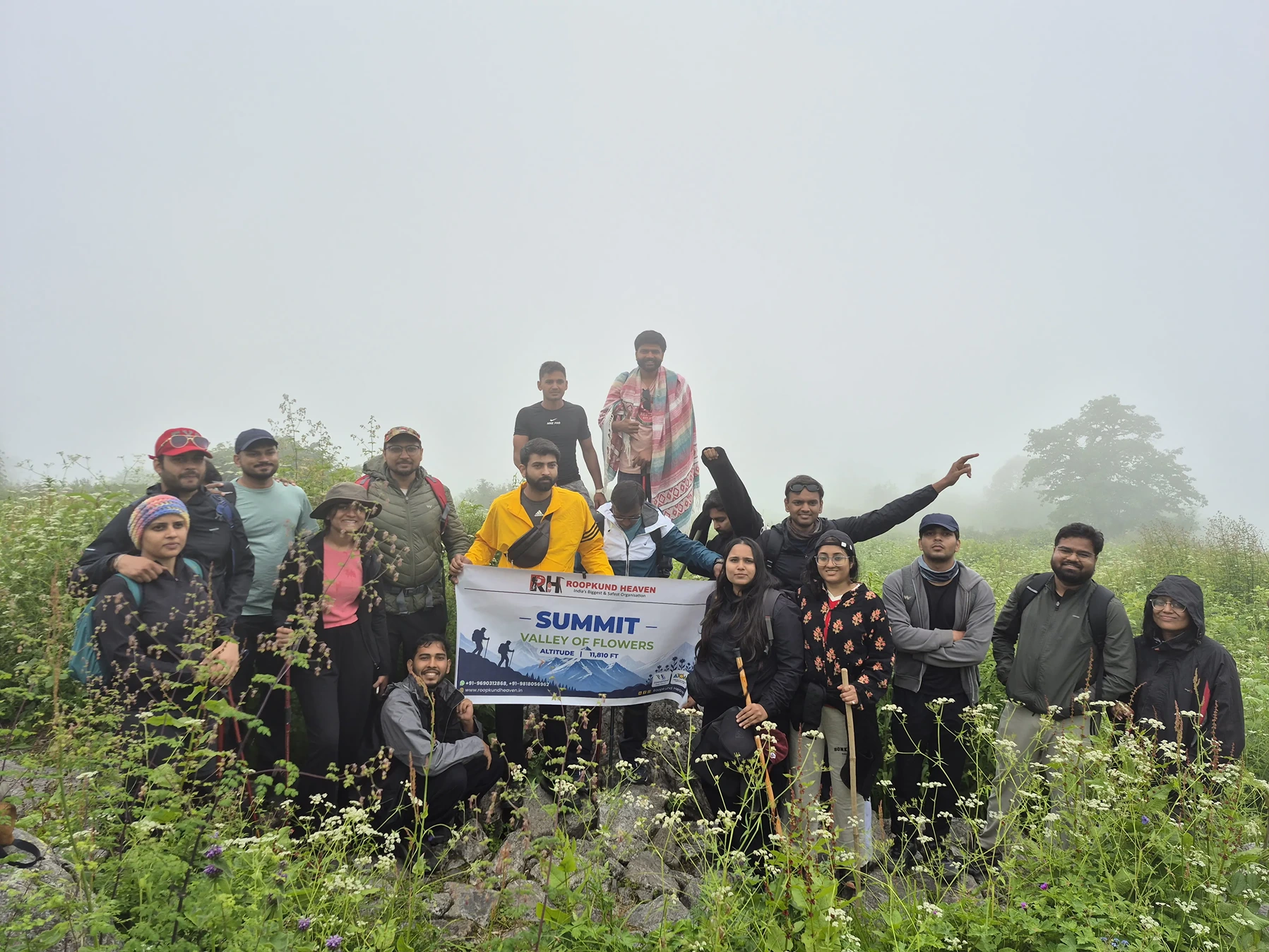
Early September can still be exceptionally green, with numerous flowering species visible across the valley. As the month progresses, some blooms begin to fade and the landscape starts developing more autumnal shades.
The advantage is visibility.
During heavy monsoon periods, clouds can hide the surrounding mountains. As rainfall gradually reduces, September can provide better opportunities to see the dramatic Himalayan landscape surrounding the valley.
For photographers, this combination can be particularly rewarding.
Instead of photographing only close-up flowers, you can capture:
flowers + green valley + waterfalls + streams + Himalayan mountains.
Early September vs Late September: Which Is Better?
If flowers are your main priority, early September is generally the safer choice.
Early September
You are more likely to find:
- More surviving flowers
- Rich greenery
- Active streams and waterfalls
- A stronger monsoon character
- Greater floral variety
However, occasional rainfall and cloudy weather are still possible.
Mid-September
Mid-September offers a balance between flowers and improving weather.
You may encounter fewer blooms than in August, but clearer skies and cooler conditions can compensate.
Late September
By late September, the floral display can be significantly reduced.
However, the valley can still be spectacular for trekkers interested in landscapes, solitude and Himalayan scenery rather than maximum flower density.
Therefore, if your primary purpose is seeing flowers, target late August to early or mid-September rather than waiting until the end of the month.
Valley of Flowers Trek Best Time
The Valley of Flowers trek best time depends on what you want to experience.
June
The trekking season begins around early summer, with snowmelt and fresh greenery gradually transforming the landscape.
July
Monsoon moisture triggers extensive flowering. The valley becomes intensely green, although rain can affect trekking conditions and mountain visibility.
August
August is one of the classic periods for colourful flowers and dense vegetation.
September
September provides one of the most balanced experiences—flowers can still be present, especially earlier in the month, while rainfall generally begins decreasing.
October
The landscape becomes more autumnal and the flowering season largely winds down as temperatures fall.
Official Uttarakhand Tourism currently describes July to September as the prime flowering period and states that the reserve is generally accessible from May to October.
For travellers primarily interested in photography and a mixture of flowers and clearer mountain scenery, early September is one of the most attractive windows.
Valley of Flowers Trek Opening Date
The Valley of Flowers trek opening date normally falls around the beginning of June, while access continues into autumn, subject to official forest regulations and weather.
However, opening and closing dates can be formally announced for each season.
Therefore, travellers should verify the current year’s official forest and tourism notification before finalising transport or accommodation.
This is particularly important because heavy snowfall, landslides, trail conditions or administrative decisions can affect access.
Do not rely exclusively on an old blog when checking the Valley of Flowers trek opening date.
Valley of Flowers Trek KM: How Long Is the Trek?
There is considerable confusion online regarding the Valley of Flowers trek km because different websites calculate the distance differently.
The traditional journey can broadly be understood as:
Govindghat → Pulna → Ghangaria → Valley of Flowers → Ghangaria → Pulna/Govindghat
Road access toward Pulna has changed how some operators calculate the walking distance.
Official Uttarakhand Tourism’s published itinerary describes Govindghat to Ghangaria as approximately 15 km and Ghangaria to the Valley of Flowers as approximately 4 km one way.
The actual walking distance will therefore depend on your roadhead, how far you explore inside the valley and whether your itinerary also includes Hemkund Sahib.
When comparing packages, always ask whether the advertised Valley of Flowers trek km represents:
- One-way trekking distance
- Round-trip trekking distance
- Only Ghangaria to the valley
- The complete itinerary including Hemkund Sahib
This will give you a much more accurate comparison.
Valley of Flowers Trek Time
The Valley of Flowers trek time should be considered in two ways: the number of days required for the complete trip and the number of hours walked each day.
Most organised itineraries take approximately 5–7 days, depending on the starting city and whether Hemkund Sahib is included.
For the actual Valley of Flowers day, trekkers usually start early from Ghangaria, trek approximately 4 km to reach the valley, explore it and return to Ghangaria the same day. Uttarakhand Tourism also recommends an early start for this section.
Your walking time will vary according to:
- Fitness
- Trail conditions
- Weather
- Photography stops
- How far you explore inside the valley
- Group pace
Starting early is particularly important because overnight stays inside Valley of Flowers National Park are not part of the normal visitor experience; Ghangaria functions as the primary base.
Valley of Flowers Trek Map and Route
A simple Valley of Flowers trek map can be understood as:
Rishikesh/Dehradun → Joshimath → Govindghat → Pulna → Ghangaria → Valley of Flowers
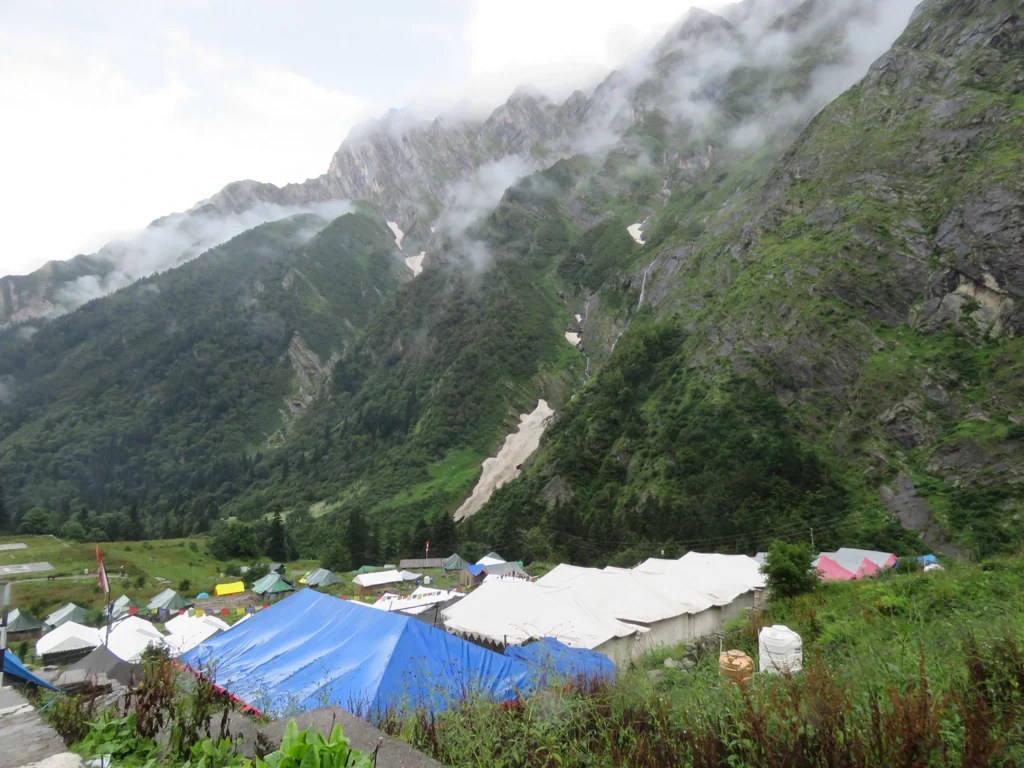
Ghangaria is the key base settlement.
From Ghangaria, two major trails separate:
Route 1: Ghangaria → Valley of Flowers
Route 2: Ghangaria → Hemkund Sahib
This makes Ghangaria strategically important for trekkers planning to experience both destinations.
The official Uttarakhand Tourism itinerary likewise uses Govindghat and Ghangaria as the principal approach to Valley of Flowers.
Valley of Flowers Trek Itinerary
A practical Valley of Flowers trek itinerary can be planned over approximately six days.
Day 1: Rishikesh/Dehradun to Govindghat
Begin the long mountain drive toward Joshimath and Govindghat.
The route follows the Alaknanda Valley and passes several important Himalayan towns and river confluences.
Overnight near Govindghat.
Day 2: Govindghat/Pulna to Ghangaria
Drive to the available roadhead and begin trekking toward Ghangaria.
The trail follows a beautiful mountain valley with rivers, waterfalls, forests and settlements along the way.
Ghangaria becomes your base for the next part of the journey.
Day 3: Ghangaria to Valley of Flowers and Back
This is the highlight of the Valley of Flowers Trek.
Start early and enter the national park.
The trail gradually reveals waterfalls, alpine vegetation, colourful flowers and the enormous glacial valley.
Spend adequate time exploring and photographing the landscape before returning to Ghangaria.
Day 4: Ghangaria to Hemkund Sahib and Back
Trekkers can optionally include Hemkund Sahib.
The climb is significantly steeper and reaches a much higher altitude than the Valley of Flowers trail.
After visiting Hemkund Sahib, descend to Ghangaria.
Day 5: Ghangaria to Pulna/Govindghat
Retrace the trail downhill and return toward Govindghat.
Depending on your schedule, continue toward Joshimath or stay nearby.
Day 6: Govindghat/Joshimath to Rishikesh
Drive back through the Alaknanda Valley and complete your Himalayan journey.
This itinerary can be modified according to transportation, accommodation, acclimatisation and current road conditions.
Valley of Flowers Trek Cost
The Valley of Flowers trek cost varies substantially between independent travel and organised packages.
Official Uttarakhand Tourism currently displays an example 6-night/7-day itinerary with an indicative budget of around ₹12,000 per person excluding airfare, but this should be treated as a reference itinerary rather than a universal market price.
Actual costs depend on:
- Starting point
- Transportation
- Hotel category
- Number of days
- Meals
- Guide services
- Entry permits
- Group size
- Hemkund Sahib inclusion
- Porter or mule services
- Personal expenses
A cheaper package is not necessarily better.
Before booking, check exactly what the quoted Valley of Flowers trek cost includes.
What Flowers Can You See in September?
Valley of Flowers supports remarkable botanical diversity.
Uttarakhand Tourism notes that more than 600 species occur in the region and mentions orchids, poppies, primulas, marigolds, daisies and anemones among its notable flowers.
Exactly what you see in September varies because flowering depends on:
- Seasonal rainfall
- Temperature
- Snowmelt
- Elevation
- Location within the valley
- Timing within the month
This is an important point.
The Valley of Flowers is a natural ecosystem, not a maintained flower garden. No operator can guarantee that a specific flower will be blooming on a particular date.
That unpredictability is part of the experience.
Is September Good for Photography?
Yes. In some respects, September can be better than peak monsoon.
During July and August, intense clouds and rainfall can sometimes obscure the surrounding mountains.
September can offer a stronger combination of:
remaining flowers + green landscapes + dramatic clouds + improving visibility + Himalayan peaks.
Photographers may also benefit from fewer people on certain dates.
Carry weather protection for your camera because rain can still occur.
How Difficult Is the Valley of Flowers Trek?
The Valley of Flowers Trek is generally considered a moderate Himalayan trek.
It does not require technical mountaineering skills, but trekkers should still prepare physically.
Challenges include:
- Long walking days
- Continuous ascents and descents
- Rain and slippery trails
- High altitude
- Changing weather
- Steeper terrain if Hemkund Sahib is included
Uttarakhand Tourism describes its Valley of Flowers itinerary as moderate to challenging.
Beginners can undertake the trek with suitable fitness preparation and sensible acclimatisation.
September Weather in Valley of Flowers
September is a transition month.
Early September can retain monsoon conditions, while later September generally becomes cooler and drier.
You should still prepare for:
- Sudden rain
- Cloud cover
- Cold mornings
- Cool evenings
- Wet trails
- Rapid weather changes
A bright morning can become cloudy surprisingly quickly in the Himalayas.
Therefore, waterproof protection remains essential even if the weather forecast looks favourable.
What to Pack for Valley of Flowers in September
Your packing should focus on both rain protection and cold-weather layering.
Important items include:
- Waterproof trekking shoes
- Rain jacket or poncho
- Backpack with rain cover
- Quick-dry trekking trousers
- Thermal or warm base layer
- Fleece
- Lightweight insulated jacket
- Trekking pole
- Sun cap
- Sunglasses
- Sunscreen
- Water bottle
- Personal medication
- Small first-aid kit
- Headlamp
- Extra socks
- Waterproof protection for electronics
Avoid carrying unnecessary weight.
September weather can change quickly, so a proper layering system is more useful than relying on one heavy jacket.
Is Valley of Flowers Trek in September Worth It?
Yes, particularly during early September.
If your only objective is seeing the maximum possible density of flowers, July and August may have an advantage.
But if you want a more balanced Himalayan trekking experience, September can be exceptional.
You can still experience flowers while potentially benefiting from decreasing rainfall, cooler temperatures, improving visibility and beautiful mountain landscapes.
Uttarakhand Tourism itself highlights late August to early September as an excellent period for the trek.
So don’t think of September as simply being “too late.”
Think of it as experiencing the Valley of Flowers in transition.
Important FAQs About Valley of Flowers Trek
1. Is September a good time for the Valley of Flowers Trek?
Yes. September remains a good time for the Valley of Flowers Trek, particularly during the first half of the month. Flowers are still visible while rainfall may gradually reduce and mountain visibility can improve.
2. Are there still flowers in Valley of Flowers in September?
Yes. Uttarakhand Tourism specifically notes flowering during August and September, although the density and variety naturally vary throughout the season.
3. What is the Valley of Flowers trek best time?
The Valley of Flowers trek best time for maximum flowering is generally July through August into early September. September is particularly attractive for trekkers seeking a combination of flowers and potentially improving weather.
4. What is the Valley of Flowers trek opening date?
The Valley of Flowers trek opening date generally falls around the beginning of June. Exact seasonal opening and closing dates should always be checked against current official notifications before travel.
5. How many km is the Valley of Flowers Trek?
The answer to Valley of Flowers trek km depends on where the distance is measured from. Official Uttarakhand Tourism describes Govindghat to Ghangaria as approximately 15 km and Ghangaria to Valley of Flowers as approximately 4 km.
6. What is the Valley of Flowers trek time?
Most complete itineraries require approximately 5–7 days depending on the starting point and whether Hemkund Sahib is included. The Valley itself is normally explored as a day trek from Ghangaria.
7. What is the standard Valley of Flowers trek itinerary?
A common Valley of Flowers trek itinerary follows:
Rishikesh/Dehradun → Joshimath/Govindghat → Pulna → Ghangaria → Valley of Flowers → Hemkund Sahib → Ghangaria → Govindghat → Rishikesh.
Hemkund Sahib can be omitted if required.
8. What is the Valley of Flowers trek cost?
The Valley of Flowers trek cost depends on transportation, accommodation, meals, guides, permits and trip duration. Uttarakhand Tourism currently lists an example 6-night/7-day itinerary at approximately ₹12,000 per person excluding airfare, but current commercial package prices can differ.
9. Is the Valley of Flowers Trek suitable for beginners?
Yes, reasonably fit beginners can undertake it. Regular walking, stair climbing and basic cardiovascular preparation before the trek are recommended.
10. Do I need a guide for the Valley of Flowers Trek?
The route is well established, but travelling with an experienced local guide can help with logistics, weather decisions, local information and understanding the flora.
11. Can we stay overnight inside the Valley of Flowers?
Visitors normally return to Ghangaria after exploring the Valley of Flowers. Ghangaria serves as the primary accommodation base for the trek.
12. What does the Valley of Flowers trek map look like?
The basic Valley of Flowers trek map follows:
Govindghat → Pulna → Ghangaria → Valley of Flowers
Ghangaria also connects to the separate trail leading to Hemkund Sahib.
13. Is Hemkund Sahib included in the Valley of Flowers Trek?
Many organised itineraries include Hemkund Sahib because both trails use Ghangaria as their base. However, Hemkund Sahib is a separate, higher and steeper trek and is not mandatory for visiting the Valley of Flowers.
14. Is September better than August for Valley of Flowers?
It depends on your priority. August usually offers denser flowering and greener monsoon landscapes, while September can offer a better balance of remaining flowers, cooler conditions and potentially clearer mountain views.
15. Is late September too late for Valley of Flowers?
Not necessarily, but visitors primarily interested in flowers should prefer early September. By late September, the number of blooms can decline considerably as autumn approaches.
Final Verdict: Should You Do the Valley of Flowers Trek in September?
The Valley of Flowers Trek in September is definitely still worth visiting, provided you arrive with the right expectations.
September is not simply an inferior version of July or August.
It offers a different Himalayan experience.
The valley is transitioning toward autumn. Flowers can still decorate its meadows, particularly earlier in the month, while the weakening monsoon can create better opportunities for mountain views.
For trekkers who want to experience flowers, waterfalls, alpine landscapes, photography and Himalayan scenery in one journey, early September can be one of the most rewarding periods of the entire season.
If your schedule allows, target the first half of September for the strongest balance between floral beauty and improving weather.
Before booking, verify the current Valley of Flowers trek opening date, understand the actual Valley of Flowers trek km, compare the complete Valley of Flowers trek cost, study the Valley of Flowers trek map, and choose a Valley of Flowers trek itinerary that allows enough time to enjoy the valley rather than rushing through it.
The flowers may be the reason you come—but in September, the entire Himalayan landscape may become the reason you remember the trek.