High in the Garhwal Himalayas of Uttarakhand lies a small glacial lake with a story unlike almost any other trekking destination in India. Roopkund is surrounded by towering mountains, alpine meadows and dramatic Himalayan landscapes, but its worldwide fame comes from something far more mysterious: hundreds of human skeletal remains found in and around the lake.
This is why Roopkund is popularly known as Skeleton Lake.
For decades, researchers, historians and local communities have tried to understand the Roopkund trek skeletons. Were they soldiers? Pilgrims? Victims of a violent Himalayan storm? And perhaps most intriguingly, why did people from apparently different parts of the world die at this remote Himalayan lake?
Modern DNA research has answered some questions—but it has also made the mystery considerably more interesting.
For trekkers researching the Roopkund trek 2026, understanding this history adds an entirely different dimension to a trail already famous for Ali Bugyal, Bedni Bugyal, Mt. Trishul and Nanda Ghunti.
Where Is Roopkund Skeleton Lake?
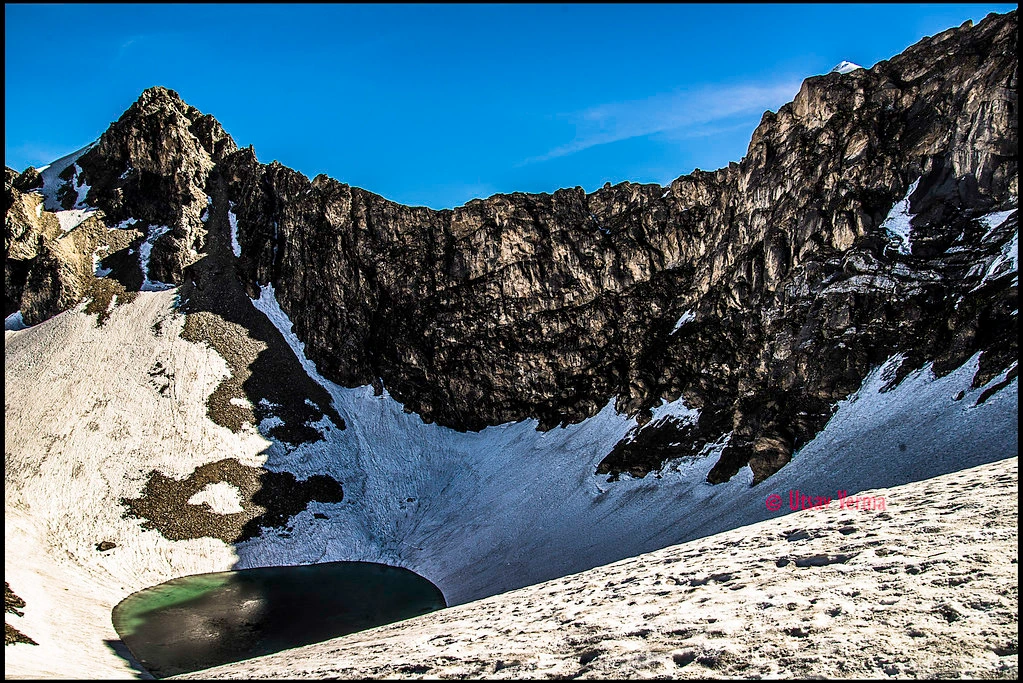
Roopkund is a high-altitude glacial lake located in the Chamoli district of Uttarakhand, within the Garhwal Himalayas. It lies at roughly 5,000 metres above sea level, depending on the exact elevation reference used.
The lake itself is relatively small. For much of the year, snow and ice dominate the landscape. Historically, when the snow melted, human bones and skulls could be seen around the lake and its surrounding slopes.
Scientific literature describes the site as containing the scattered remains of several hundred individuals.
That extraordinary concentration of human remains gave Roopkund its famous nickname—Skeleton Lake.
Why Is Roopkund Called Skeleton Lake?
The answer is straightforward, but the story behind it is not.
Roopkund is called Skeleton Lake because hundreds of ancient human skeletal remains have been discovered around the lake. The bones include skulls and other skeletal elements belonging to both men and women.
For many years, it was assumed that virtually everyone at Roopkund had died during one catastrophic event.
Modern research has challenged that assumption.
A major 2019 study published in Nature Communications analysed genome-wide ancient DNA from 38 individuals found at Roopkund. Researchers discovered that the individuals belonged to three genetically distinct groups and that their deaths occurred during different periods.
This means Skeleton Lake was probably not created by one single disaster.
And that is where the real Roopkund mystery begins.
When Were the Roopkund Skeletons Discovered?
The skeletal remains became widely known after they were reported in 1942 by a British forest guard.
The discovery immediately generated speculation.
This was during World War II, and one early concern was that the bodies might have belonged to soldiers. But it eventually became clear that many of the remains were far older.
The unusual preservation of bones in the cold, high-altitude environment helped turn Roopkund into one of India’s most fascinating archaeological mysteries.
Over subsequent decades, different explanations emerged concerning who these people were and why they died.
The Biggest Theories Behind the Roopkund Trek Skeletons
Before modern genetic research, several theories attempted to explain the human remains.
Theory 1: A Lost Army
One early hypothesis suggested that the skeletons belonged to soldiers who had attempted to cross the Himalayas.
However, later evidence weakened the military theory.
The 2019 genetic study examined individuals of both sexes—23 genetically male and 15 genetically female among the 38 people for whom genome-wide data were obtained. Researchers noted that this relatively balanced presence of men and women was difficult to reconcile with the theory of a military expedition.
Theory 2: Pilgrims Travelling Through the Himalayas
This remains an important possibility for at least some of the individuals.
Roopkund lies near the route associated with the traditional Nanda Devi Raj Jat, one of Uttarakhand’s most culturally important Himalayan pilgrimages.
Researchers have therefore considered whether some of the earlier individuals may have been pilgrims travelling through the region.
Scientific analysis does not conclusively prove this explanation, but the 2019 study described death during a pilgrimage as a plausible hypothesis for at least some of the South Asian individuals.
Theory 3: A Deadly Hailstorm
Perhaps the most famous explanation for the Roopkund skeletons is a catastrophic hailstorm.
Some skull injuries were historically interpreted as being consistent with heavy objects striking people from above. This led to the dramatic theory that a group travelling near Roopkund was trapped in an extreme Himalayan hailstorm and killed.
Osteological analysis discussed in the scientific research identified several individuals with unhealed compression fractures and considered a violent hailstorm as one possible explanation.
However, researchers also explicitly acknowledged that other scenarios are possible.
Therefore, it is misleading to claim that science has definitively proved that giant hailstones killed everyone at Roopkund.
What DNA Research Revealed About Roopkund Skeletons
This is where the story becomes extraordinary.
The 2019 Nature Communications study used ancient DNA, radiocarbon dating, isotope analysis and osteological evidence to investigate the remains.
Scientists successfully obtained genome-wide data from 38 individuals.
Instead of finding one homogeneous group, they identified three genetically distinct populations.
Group 1: South Asian-Related Individuals
Twenty-three individuals possessed ancestry within the range of present-day South Asian populations.
Their remains dated broadly to approximately the 7th–10th centuries CE.
Interestingly, even these individuals may not all have died simultaneously.
Group 2: Eastern Mediterranean-Related Individuals
Fourteen individuals possessed ancestry characteristic of the eastern Mediterranean.
These remains were dramatically younger, dating broadly to the 17th–20th centuries CE.
Genetic analysis found that this group showed particular affinity with present-day people from Crete, although the researchers specifically cautioned that this does not mean they necessarily came from Crete itself.
Group 3: Southeast Asian-Related Individual
Researchers also identified one individual with Southeast Asian-related ancestry.
This individual belonged to the later chronological period.
The 1,000-Year Mystery of Skeleton Lake
Perhaps the most important discovery was not simply where these people came from.
It was when they died.
Radiocarbon dating showed that the remains were deposited during events separated by roughly 1,000 years.
That completely changed the traditional interpretation of Skeleton Lake.
Instead of:
One group → One disaster → Hundreds of deaths
the evidence points toward:
Different groups → Different periods → Multiple events
This means there may never be one universal explanation for all the Roopkund skeletons.
A hailstorm, pilgrimage accident or other catastrophe might potentially explain one group without explaining another.
Why Were Mediterranean People at Roopkund?
This remains one of the greatest unanswered questions.
The later group contained unrelated men and women whose genetic ancestry pointed toward the eastern Mediterranean.
But why would such travellers have reached an isolated Himalayan location hundreds of years ago?
Researchers could not establish a definitive answer.
They considered that the individuals or their recent ancestors likely originated in the eastern Mediterranean region. Their isotope signatures also suggested dietary differences from the South Asian group.
But their purpose for travelling to Roopkund remains unknown.
Were they explorers?
Travellers?
Pilgrims?
Part of an undocumented expedition?
No conclusive historical record has yet provided the complete answer.
This unresolved question is one reason why Roopkund continues to deserve the title of one of India’s greatest Himalayan mysteries.
What Makes the Roopkund Trek Special Beyond Skeleton Lake?
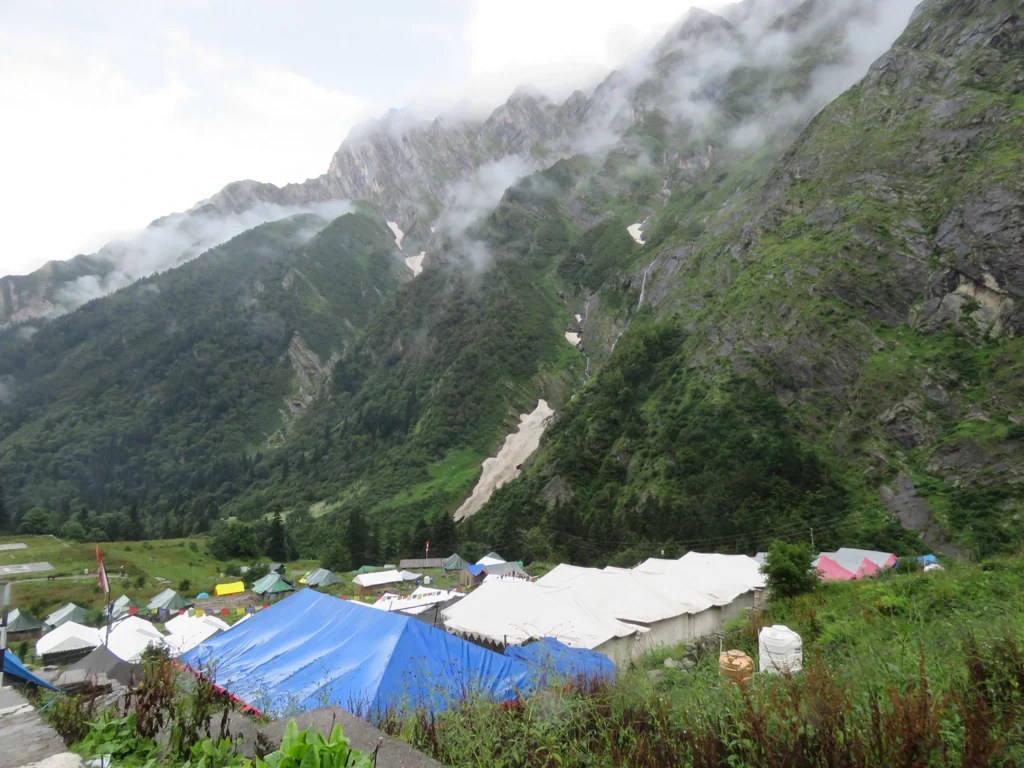
Although Skeleton Lake made Roopkund internationally famous, the trek itself became legendary because of its extraordinary Himalayan terrain.
The classic route is associated with landscapes such as:
- Lohajung
- Didina
- Ali Bugyal
- Bedni Bugyal
- Patar Nachauni
- Bhagwabasa
- Roopkund
Among these, Ali Bugyal and Bedni Bugyal are especially famous for their vast high-altitude grasslands.
Trekkers also encounter magnificent views of Himalayan giants such as Mt. Trishul and Nanda Ghunti.
The combination of alpine meadows, high-altitude terrain, local mythology, archaeology and the mysterious lake made the Roopkund Trek one of the most recognised trekking routes in India.
Roopkund Trek Distance
The exact Roopkund trek Distance varies according to the route, campsite configuration and starting/ending point used by an operator.
For the traditional trekking route, travellers should expect several days of hiking through progressively higher Himalayan terrain rather than treating Roopkund as a short lake excursion.
When comparing a Roopkund trek package, always check whether the stated distance represents:
- trekking distance only,
- road plus trekking distance,
- one-way distance, or
- the complete walking itinerary.
This prevents misleading comparisons between different packages.
Roopkund Trek Difficulty Level
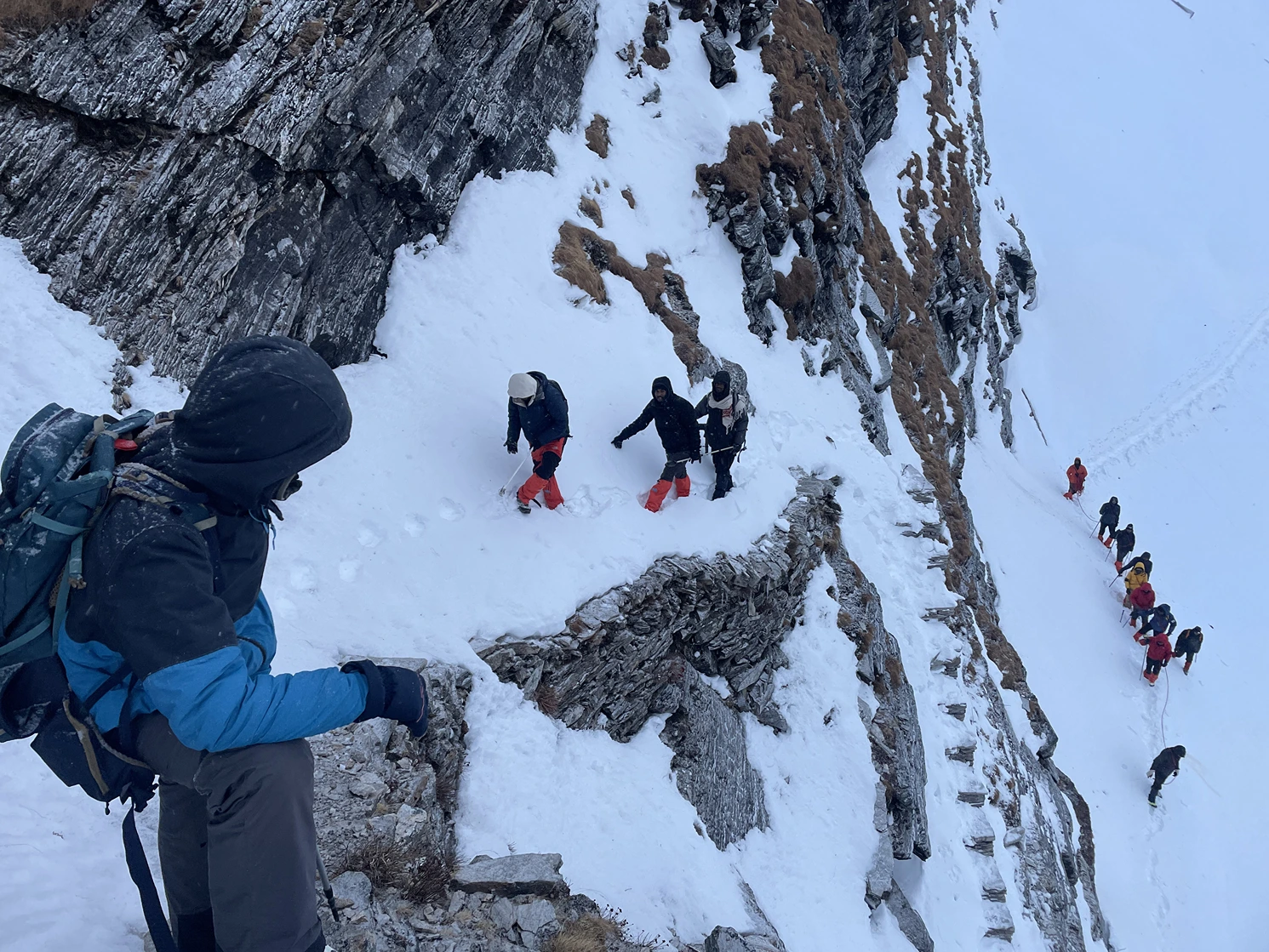
The Roopkund trek difficulty level has traditionally been considered moderate-to-difficult or difficult, depending on itinerary and conditions.
The major challenges include:
High altitude: Roopkund lies at approximately 5,000 metres, where oxygen availability is considerably lower than at lower elevations.
Long trekking days: The route involves sustained walking through changing Himalayan terrain.
Steep sections: Higher sections can involve demanding ascents and descents.
Weather: Conditions in the Himalayas can change rapidly.
Cold: Temperatures at higher camps and around the lake can become severe.
Acclimatisation: Ascending too quickly significantly increases altitude-related risk.
The historical popularity of Roopkund should therefore never be confused with it being an easy beginner trek.
Roopkund Trek Best Time
Historically, the Roopkund Trek best time was generally associated with two trekking windows:
May to June for late-spring and early-summer conditions, and September to October for clearer post-monsoon mountain views.
However, current regulations and permitted access are more important than seasonal preference.
Anyone researching a Roopkund trek 2026 should verify the latest official forest, tourism and local administrative rules before planning the traditional route.
Why Roopkund Trek Is Banned – What Actually Happened?
The question “Why Roopkund trek is banned?” requires some clarification.
The issue is closely connected to environmental protection of Uttarakhand’s fragile high-altitude meadows, locally called bugyals.
The traditional Roopkund trail depends heavily on areas such as Ali Bugyal and Bedni Bugyal. Restrictions affecting camping and tourism activity in sensitive alpine meadows therefore had a major impact on commercial operation of the classic trek.
As a result, the traditional Roopkund itinerary became inaccessible or operationally impractical for regular trekking groups.
It is better to describe this as a consequence of environmental restrictions and access regulations rather than simply assuming that Skeleton Lake itself was permanently “banned.”
For Roopkund trek, travellers should rely on the latest official notifications rather than old blogs or trekking itineraries because access rules can change.
Roopkund Trek 2026: What Trekkers Should Check
If you are considering Roopkund in 2026, do not book solely because an operator advertises the trek online.
Before paying for a Roopkund trek package, confirm:
- Whether the proposed route is currently legally permitted
- Forest permissions required
- Current camping restrictions
- Permitted campsites
- Group-size regulations
- Whether access to Roopkund Lake itself is allowed
- Guide requirements
- Waste-management regulations
- Exact itinerary being offered
- Cancellation terms if permits are refused
This is particularly important because older Roopkund itineraries available online may reflect regulations from before restrictions were introduced.
Roopkund Trek Package: What Should It Include?
A professionally organised Roopkund trek package, whenever the route is officially permitted, should clearly state what is and is not included.
Typical components may include accommodation, trekking meals, trained trek leaders, local guides, camping equipment where camping is legally permitted, forest permissions, safety equipment and logistical support.
The package should also clearly explain transportation arrangements and any additional charges.
More importantly, the operator should be transparent about the current legal status of the route.
Avoid packages that promise access to restricted areas without explaining permits or regulations.
Roopkund Trek Cost
The Roopkund trek cost cannot be treated as one permanent figure.
Pricing depends on factors such as:
- Trek duration
- Transportation
- Group size
- Accommodation
- Guide-to-trekker ratio
- Permits
- Equipment
- Meals
- Safety arrangements
- Route modifications
- Current government regulations
Therefore, comparing packages only by the lowest advertised price can be misleading.
For the Roopkund trek 2026, legality, safety standards and the actual permitted itinerary should be checked before comparing prices.
History, Folklore and Science: Which Story Is Correct?
This is what makes Roopkund fascinating: there may not be one single story.
Local folklore connects the region with Nanda Devi and pilgrimage traditions.
Historical theories proposed armies, traders and travellers.
Physical anthropology raised the possibility of violent weather.
Modern genetics demonstrated that the people represented different ancestral groups and different periods.
Science has therefore solved part of the mystery while simultaneously making the overall story more complex.
What can now be stated with confidence is that the hundreds of Roopkund remains should not automatically be interpreted as victims of one single disaster.
The scientific evidence indicates multiple episodes of death separated by centuries.
Why Roopkund Skeleton Lake Still Fascinates the World
There are hundreds of beautiful glacial lakes in the Himalayas.
There is only one Roopkund.
Imagine reaching an isolated lake more than 5,000 metres above sea level and discovering hundreds of human remains.
Then imagine learning that some individuals died more than a millennium ago while others arrived many centuries later—and that one group apparently had ancestry associated with a region thousands of kilometres away.
That combination of geography, archaeology, genetics, folklore and unanswered questions makes Roopkund much more than a trekking destination.
It is a historical puzzle preserved in the Himalayas.
Conclusion
Why is Roopkund called Skeleton Lake? The immediate answer is simple: hundreds of human skeletal remains were discovered around its frozen waters.
But explaining how those remains arrived there is far more complicated.
Modern science has established that the Roopkund trek skeletons represent people from different genetic backgrounds and, crucially, different periods of history. Some possessed South Asian-related ancestry and died more than a thousand years ago. Others with eastern Mediterranean-related ancestry arrived centuries later.
The old idea of one group being wiped out in one mysterious Himalayan disaster can no longer explain the entire site.
That is what makes Roopkund extraordinary.
For trekkers researching the Roopkund trek 2026, Skeleton Lake represents far more than an adventurous Himalayan destination. It is where trekking, archaeology, local folklore and cutting-edge genetic science meet—and where some of the most interesting questions still remain unanswered.
FAQs
1. Why is Roopkund called Skeleton Lake?
Roopkund is called Skeleton Lake because the remains of several hundred humans have been found scattered around the high-altitude glacial lake.
2. How old are the Roopkund trek skeletons?
There is no single age for all the skeletons. Scientific dating indicates that some individuals date to approximately the 7th–10th centuries CE, while another group dates to roughly the 17th–20th centuries CE.
3. Who were the people found at Roopkund Lake?
DNA analysis of 38 individuals identified 23 with South Asian-related ancestry, 14 with eastern Mediterranean-related ancestry and one with Southeast Asian-related ancestry.
4. Did everyone at Roopkund die in one incident?
No. Modern radiocarbon dating shows that the remains were deposited during multiple events, with major groups separated by roughly 1,000 years.
5. Were the Roopkund skeletons killed by a hailstorm?
A violent hailstorm is one proposed explanation, and injuries observed on some remains have been discussed in relation to this possibility. However, scientific research does not establish a hailstorm as the definitive cause of death for all the people found at Roopkund.
6. Why Roopkund trek is banned?
The traditional route was heavily affected by environmental restrictions concerning camping and tourism activity in Uttarakhand’s fragile alpine meadows or bugyals. Because the classic trail depends on these areas, regular commercial trekking to Roopkund became severely restricted.
7. Is Roopkund Trek open in 2026?
The status of the Roopkund trek 2026 should be verified against current official government and forest-department permissions before booking. Trekkers should not assume that an online package automatically means the complete traditional route is legally accessible.
8. What is the Roopkund Trek difficulty level?
The Roopkund trek difficulty level is generally considered moderate-to-difficult to difficult because of its altitude, sustained trekking, cold conditions, steep sections and need for proper acclimatisation.
9. What is the Roopkund Trek best time?
Historically, May–June and September–October have been popular seasonal windows. However, the Roopkund Trek best time now also depends on whether the route is officially permitted during the intended travel period.
10. What is the Roopkund trek Distance?
The Roopkund trek Distance varies according to the route and itinerary followed. Travellers should check whether a package’s stated distance represents the entire trekking route or only a particular section.
11. How much does the Roopkund trek cost?
The Roopkund trek cost varies according to duration, transportation, permits, accommodation, meals, guides, group size and logistical arrangements. For 2026, travellers should prioritise legal access and safety over simply selecting the cheapest package.
12. What should a Roopkund trek package include?
A reliable Roopkund trek package should transparently mention the permitted itinerary, accommodation, meals, guides, transport arrangements, required permits, safety support, inclusions, exclusions and cancellation conditions.
13. Why are the Roopkund skeletons scientifically important?
The Roopkund trek skeletons are scientifically significant because DNA and radiocarbon research revealed individuals with different ancestries who died during different historical periods. The discovery challenges the older idea that everyone at Roopkund died during one catastrophic event.
14. Were foreigners really found among the Roopkund skeletons?
Genetic research identified 14 individuals with ancestry typical of the eastern Mediterranean. Researchers found genetic affinity with present-day people from Crete, but explicitly cautioned that this does not prove the individuals themselves came specifically from Crete.
15. Why did people from the Mediterranean travel to Roopkund?
Nobody knows for certain. The purpose of their journey to this remote part of the Himalayas remains one of the biggest unanswered questions surrounding Skeleton Lake.